.svg)
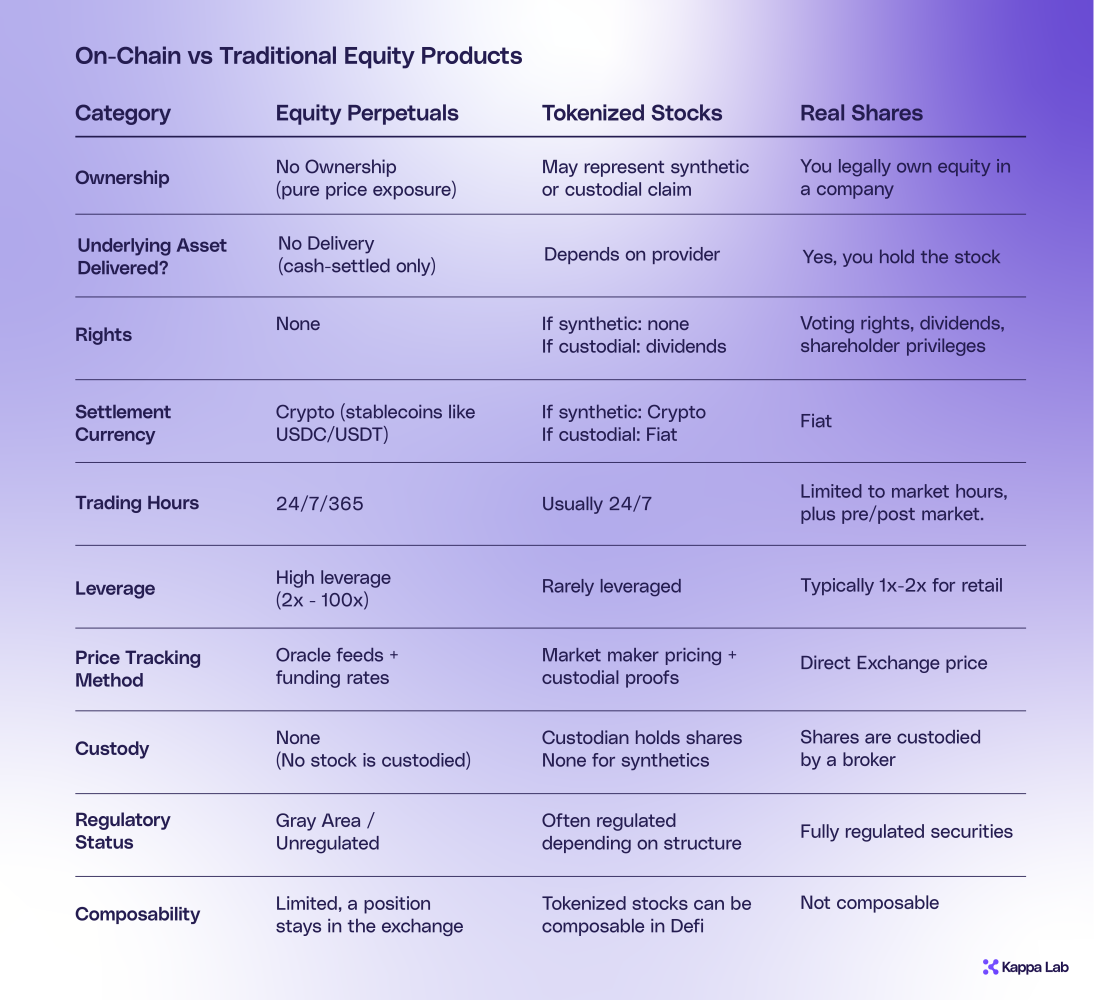
Crypto equity perpetuals, or “equity perps,” are a new class of on-chain derivatives bringing stock market exposure into the crypto arena. Unlike traditional stock ownership or tokenized stock tokens, equity perps do not represent real shares or voting rights. Instead, they are perpetual futures contracts that track a stock’s price. In simple terms, they let you take a position on an equity without owning it.
This crypto-native approach offers clear advantages: 24/7 trading, high leverage, and direct access through a wallet and stablecoins. It also introduces new risks. This article breaks down how equity perps work, why they are gaining traction among crypto traders and DeFi builders, and what challenges remain as they reshape access to equities on-chain.
What Are Equity Perpetuals? A Crypto Alternative to Stocks
Equity perps are perpetual swap contracts linked to stock prices. A perpetual swap is a derivative with no expiry date, allowing traders to hold long or short positions as long as they maintain margin collateral. The reference price is a real-world stock or index, but no stock is ever delivered.
This differs from tokenized stocks, which attempt to replicate share ownership through custodial or synthetic tokens. Equity perps make no such claim. They provide price exposure only. There are no dividends or shareholder rights, but the lack of real-world constraints makes them easier to trade and fully crypto-native.
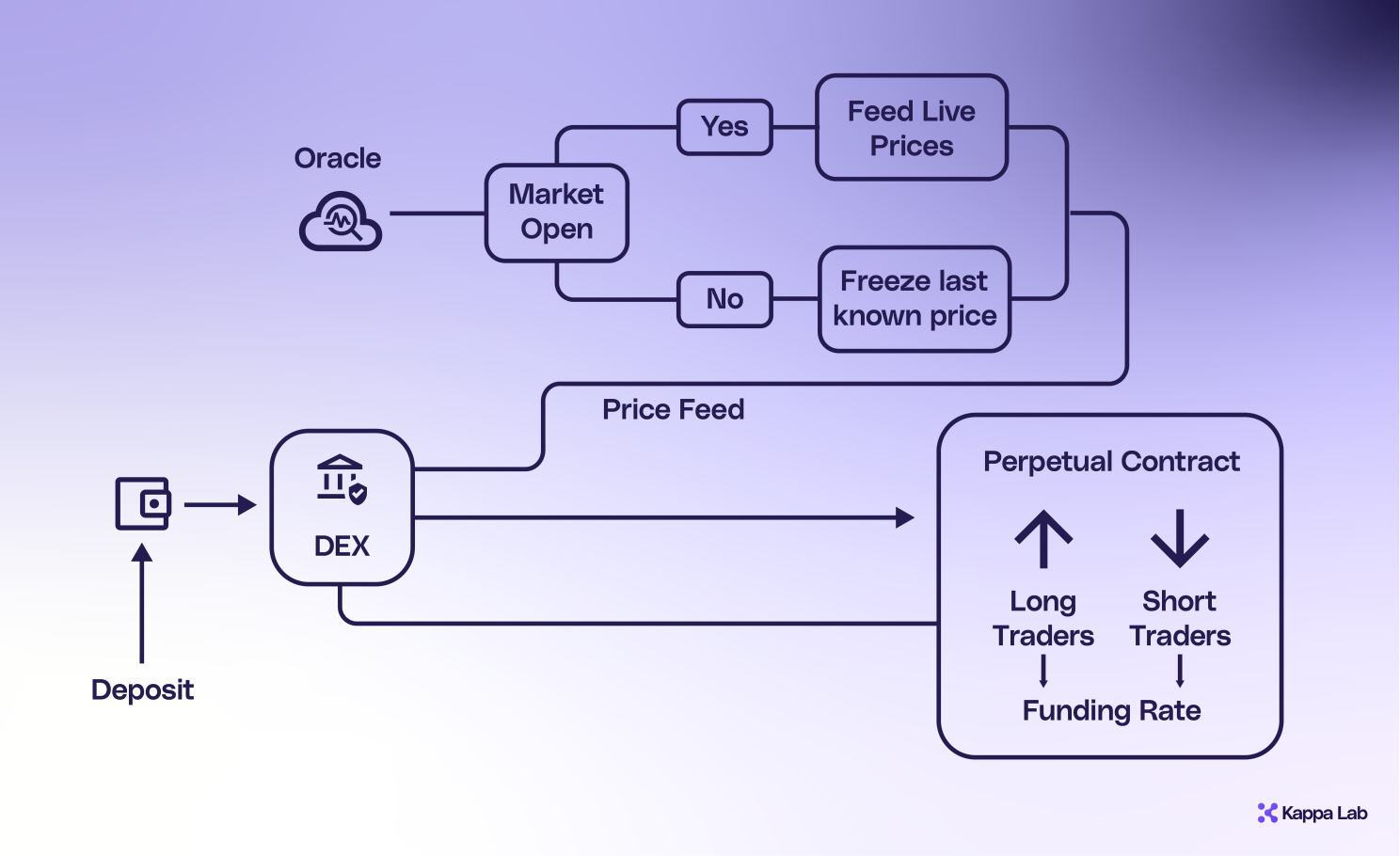
They track stock prices through two key mechanisms: oracles and funding rates. Oracles feed real-time price data from traditional markets into the contract. The funding rate, a periodic payment between longs and shorts, keeps the contract price aligned with the real price. When the perp trades above the stock price, longs pay shorts; when it trades below, shorts pay longs. This feedback loop keeps the perp close to its underlying market value.
24/7 Trading and Stablecoin Settlement
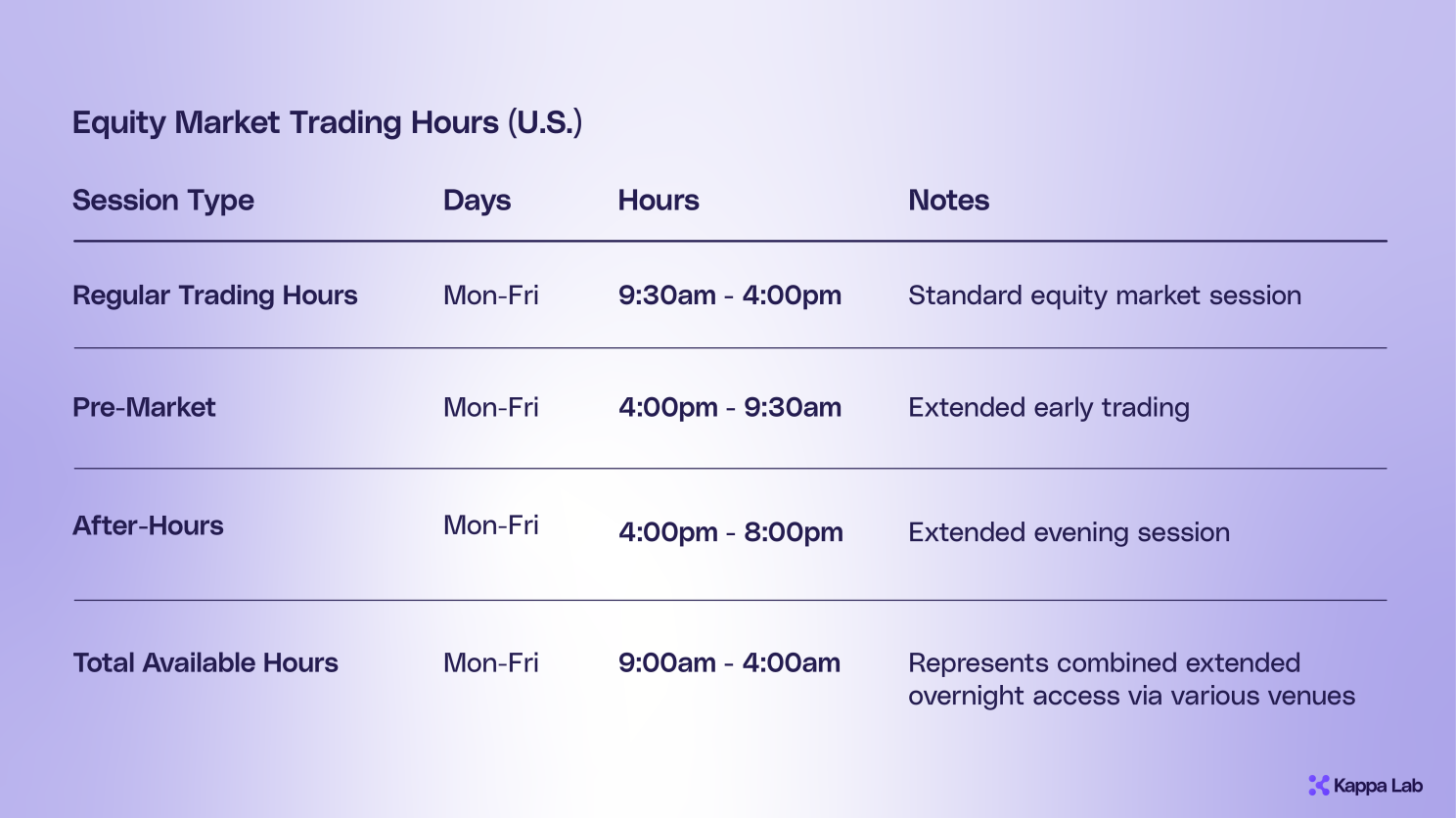
Traditional equity markets trade only a few hours per weekday. By contrast, equity perps run nonstop, every day of the year. This allows traders to react instantly to global events and news, even during weekends or holidays.
Settlement happens in stablecoins such as USDC or USDT. Traders post stablecoins as collateral, and all profits and losses are paid in the same asset. There is no need for brokers, bank transfers, or geographic restrictions. Access is global and permissionless.
Because equity perps are derivatives, there is no minting or redeeming of tokenized shares. Traders simply connect a wallet, deposit stablecoins, and take long or short positions. The process is fast and fully self-custodial, ideal for short-term trading and speculation.
Leverage and Capital Efficiency
Equity perps attract traders seeking leverage and flexibility. Traditional brokers often limit retail margin to around 2×. Crypto platforms routinely offer 5×, 10×, or even 20× leverage on equity perps. Some decentralized exchanges go further, offering 50× or more on select markets.
The reason is simple: the target audience is active traders, not long-term investors. Perps serve as an on-chain alternative to short-term stock options, giving traders a way to take amplified directional bets. For instance, instead of buying a one-day Tesla call option, a trader can open a 10× leveraged long on a Tesla perp. The experience is faster and simpler, with no option greeks or expirations to manage.
Leading Examples
- Injective (Helix): Hosts a TradFi index perpetual tracking hundreds of major U.S. equities with up to 25× leverage. Traders can gain exposure to the stock market through a single decentralized instrument. Injective also offers perpetuals on major individual equities, expanding its suite of on-chain equity markets.
- Hyperliquid (Trade XYZ): Runs the XYZ100 index perpetual, similar to a NASDAQ-100 basket, with 20× leverage and deep liquidity. Its early trading volumes exceeded $100 million within days of launch. Hyperliquid has also recently launched single-stock perpetuals, enabling direct exposure to individual equities through its on-chain derivatives markets.
- Ostium (Arbitrum): Offers equity, commodity, and forex perps using synthetic on-chain pricing. Markets like the S&P 500 and Dow Jones are available with up to 100× leverage, backed by a two-tier liquidity pool design.
These platforms demonstrate the growing appetite for 24/7, permissionless access to equity markets using crypto infrastructure.
Maintaining Price Alignment
Equity perps rely on strong price oracles and funding rates to stay aligned with real markets. Oracles aggregate data from exchanges and futures markets to generate fair prices. During market closures, they may use last-trade or futures data as proxies.
Funding rates incentivize correction. If the perp trades above fair value, longs pay shorts; if below, shorts pay longs. This mechanism, borrowed from crypto futures, has proven effective in keeping prices close to underlying assets. Arbitrage traders exploit deviations, restoring balance and ensuring that the perp reflects real-world values even outside market hours.
Benefits for Traders and Builders
- Always-on trading: React to earnings, news, or global events any time.
- Simple access: All you need is a wallet and stablecoins.
- No custody issues: No real shares or custodians involved.
- High leverage: Amplified exposure with smaller capital.
- Global reach: Available to users worldwide without brokers.
These features make equity perps a natural fit for crypto’s 24/7, permissionless trading culture.
Risks and Limitations
- Low liquidity: Markets are still thin, which can lead to slippage and liquidation risks.
- Off-hours volatility: Prices can swing sharply on weekends when traditional markets are closed.
- No investor protection: These are unregulated products without safeguards or insurance.
- Regulatory uncertainty: Future crackdowns could impact access or legality.
- Limited composability: Positions exist within the exchange, not as portable tokens for use across DeFi.
Traders must manage leverage carefully and understand that these are speculative instruments, not investments in real equities.
Reshaping Market Access
Despite the risks, equity perps are an important step toward bringing traditional markets into crypto. They merge the accessibility and efficiency of DeFi with exposure to global equities. For users in regions without easy stock market access, this is a major breakthrough.
They also signal a shift in market structure. Trading no longer stops at 4 PM. Stocks can now move on-chain at any time, reacting to real-world events in real time. Builders are already experimenting with new products built on equity perps, from synthetic ETFs to structured yield products.
Kappa Lab View
Crypto equity perpetuals are redefining how traders access and interact with equities. They offer 24/7 exposure, instant settlement, and global reach without brokers or custodians. While liquidity, regulation, and risk management still need to mature, the concept marks a fundamental shift in how markets operate.
For now, they are a niche product for active traders. But as infrastructure improves, equity perps could evolve into a core pillar of on-chain finance, standing alongside crypto futures as a gateway to global market exposure.



Your Liquidity?
.svg)
.svg)
.svg)
.svg)
Kappa Lab Capital DMCC is a proprietary trading firm registered in Dubai, UAE. It operates under a No Objection Confirmation (NOC) from the Virtual Asset Regulatory Authority (VARA).
The information on this website is not directed at nor intended for distribution to, or use by, any person resident in any country or jurisdiction where such distribution or use would be contrary to local law or regulation. The content on this website is for informational purposes only and should not be considered an offer or solicitation to engage in any financial activity.